Cracks, potholes, and crumbling edges — find out whether patching your asphalt driveway makes sense or if replacement is the smarter call.
Share:
Summary:
You’ve noticed the cracks getting wider. Maybe there’s a pothole forming near the edge, or the surface has gone from dark black to a dull, crumbling gray. The question most Polk County homeowners land on pretty quickly is: do I patch this, or do I just replace the whole thing?
It’s a fair question — and the honest answer is that it depends on what’s actually going on underneath the surface, not just what you can see from the driveway. Get that assessment wrong and you’re either spending money on a repair that won’t hold, or replacing a driveway that had years left in it. Here’s how to think through it.
Patching gets a bad reputation — mostly because people have seen it done poorly. A bag of cold patch from the hardware store, shoveled into a pothole and tamped down by hand, rarely lasts more than a season. That’s not patching. That’s a placeholder.
Professional patching is a different thing entirely. When the underlying base is still structurally sound and the damage is isolated — a section of cracking here, a pothole there — a proper full-depth patch can be just as permanent as the surrounding asphalt. The key word is “isolated.” If the damage is spread across a third or more of your driveway, or if the base itself has failed, patching becomes a losing game.
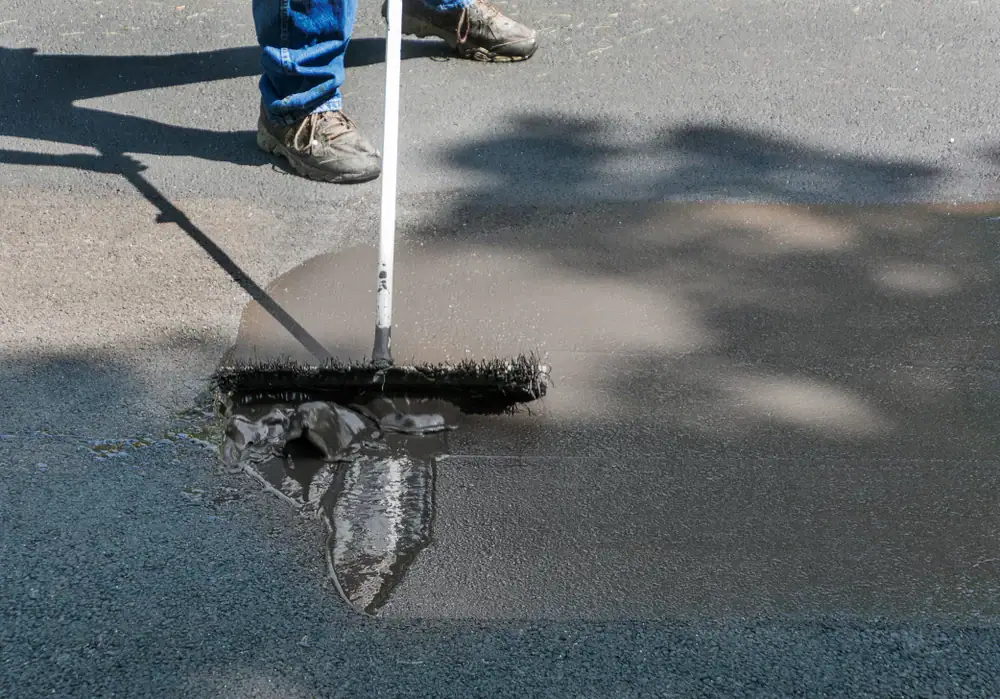
The step most contractors skip — and the one that determines whether a patch lasts three years or three months — is the base assessment. Before any material goes down, a qualified contractor needs to determine whether the base beneath your asphalt is still intact. If it isn’t, patching the surface is like painting over a water stain without fixing the leak. It looks fine for a while, and then it doesn’t.
Here in Polk County, this matters more than it does in a lot of other markets. The sandy soils throughout the Lakeland, Davenport, and Winter Haven areas are excellent for drainage, but they require careful compaction during installation. When that compaction wasn’t done right the first time — or when years of Florida’s rainy season have slowly eroded the base from below — the surface above it will keep failing no matter how many times you patch it.
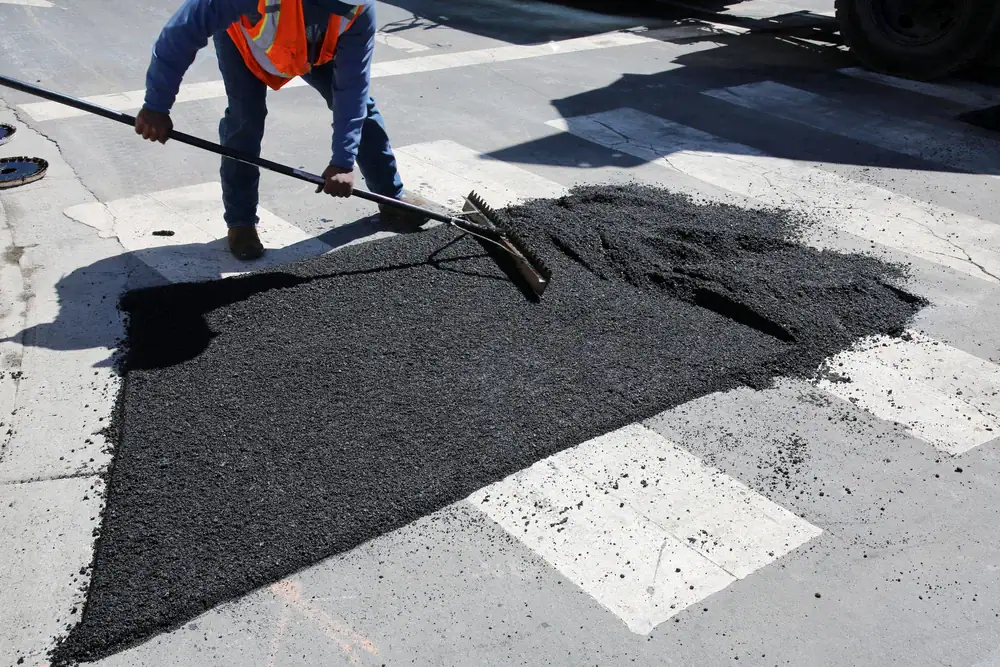
The professional process starts with saw-cutting clean, square edges around the damaged area rather than feathering new material over the old. That clean edge is what gives the patch something solid to bond to. From there, the failed asphalt is removed down to the base, the base is inspected and repaired if needed, a tack coat is applied to promote adhesion, and hot-mix asphalt is placed and mechanically compacted. That last part — mechanical compaction — is what DIY patching can’t replicate. Hand-tamping simply doesn’t achieve the density that a proper patch requires.
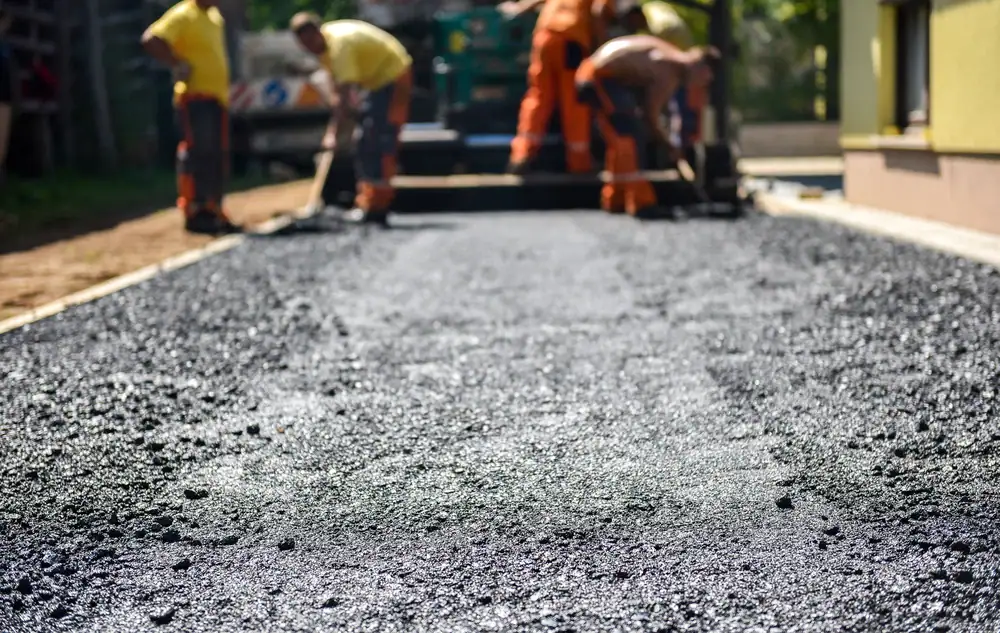
We use state-of-the-art 2023+ equipment specifically because compaction quality directly affects how long the repair holds. It’s not a cosmetic difference. A patch that’s properly compacted with modern equipment will behave like the surrounding asphalt. One that isn’t will settle, crack, and separate within a season or two.
The other thing worth knowing: we use polymer-modified asphalt mixes, not standard northern-climate materials. Florida’s summer heat — and Polk County gets plenty of it — can cause conventional asphalt to soften and rut if the wrong mix is used. Polymer-modified mixes are formulated to hold up under that heat load, which is one of the reasons material selection matters as much as technique.
Not every driveway problem is a pothole. A lot of Polk County homeowners are dealing with surface cracking — hairline cracks, edge cracking, or the early stages of what’s called alligator cracking, where the surface starts to look like a dried-up lakebed. How you handle each of these is different, and treating them the same way is one of the most common mistakes in this industry.
Narrow cracks — under a quarter inch — that aren’t spreading rapidly are strong candidates for crack sealing. A hot-applied rubberized sealant is worked into the crack, bonds to the asphalt on both sides, and prevents water from getting in. In a market that sees over 50 inches of rain annually, concentrated between June and September, that water infiltration is the real threat. A crack that looks cosmetic in April can become a pothole by August if it’s left open through rainy season.
Wider cracks and early alligator cracking are a different story. Alligator cracking — the interconnected, web-like pattern — almost always signals base movement or failure underneath. Crack-sealing over it buys a little time, but the underlying cause needs to be addressed. If the alligatoring is limited to one section of the driveway, full-depth patching of that section is often the right call. If it covers a third or more of the surface, replacement starts to make more financial sense.
This is where our experience across Polk County pays off. We’ve seen every variation of driveway failure across Lakeland, Bartow, Auburndale, Haines City, and the communities throughout the region. The judgment call between “patch this section” and “this driveway needs to come out” isn’t something you can get from a formula — it comes from having made that call hundreds of times and seeing how each one played out. We’ll give you a straight answer, not the one that’s most profitable for us.
One more thing on crack repair: timing matters. Scheduling crack sealing or patching before June — before the rainy season hits — is genuinely the smartest move you can make for a Polk County driveway. Water is the enemy of asphalt base integrity, and the window between winter and the summer storms is the best time to close off any entry points.
Want live answers?
Connect with a Central Florida Blacktop Paving expert for fast, friendly support.
There’s no shortage of contractors willing to patch your driveway. The harder part is finding one who’ll tell you the truth about whether patching is even the right move — and then do the work correctly if it is.
A few things are non-negotiable: a Florida contractor’s license (verifiable through the state’s DBPR), general liability and workers’ compensation insurance, and a written estimate that details exactly what will be done before anyone touches your driveway. Verbal quotes and vague scopes are how surprise costs happen. If a contractor won’t put it in writing, that’s your answer.
The numbers matter here, so let’s be direct about them. Professional patching typically runs between $2 and $15 per square foot depending on the method — crack sealing on the lower end, full-depth remove-and-replace patching on the higher end. Full driveway replacement in Polk County runs $8.50 to $18 per square foot installed. For an average residential driveway, that’s the difference between a few hundred dollars and a project that can reach $8,000 or more.
Patching wins financially when the damage is isolated and the base is sound. It loses when you’re patching over a failing foundation — because you’ll be back in the same conversation in 12 to 18 months, having spent money on a repair that didn’t solve the underlying problem.
There’s also a useful threshold worth knowing: if the cost of repairing your driveway approaches 30% of what full replacement would cost, and your driveway is showing widespread damage, replacement usually makes more financial sense over the long run. Similarly, if your driveway is approaching 20 years old and you’re seeing multiple failure points across the surface, continued patching is likely just deferring an inevitable replacement — and each repair adds cost without resetting the clock on the driveway’s overall lifespan.
On the other hand, if your driveway is 8 to 12 years old, has isolated damage, and a sound base, targeted patching followed by sealcoating every two to three years can realistically extend its life by another decade or more. Spending $100 to $200 a year on maintenance — crack sealing, sealcoating — is consistently cheaper than a premature replacement.
We offer free consultations specifically because this decision deserves a real assessment, not a guess. We’ll come out, look at what’s actually going on with your driveway, and give you a clear recommendation — patch, resurface, or replace — with transparent pricing attached to each option.
We’ve been doing this in Central Florida since before most of the subdivisions in Davenport and the Four Corners area existed. That’s not a boast — it’s context. The conditions here are specific, and they’re different from what contractors trained in northern markets are used to dealing with.
There’s no freeze-thaw cycle in Polk County. The cracking patterns you see here come from UV oxidation, heat expansion, water infiltration, and base movement in sandy soil — not from ice pushing up from below. A contractor who learned the trade in Ohio or Pennsylvania may not immediately recognize what they’re looking at when they see Florida-specific failure patterns. We do, because we’ve been watching them develop and addressing them here for four decades.
We also work year-round, which matters more than it sounds. Florida’s mild winters — daytime temperatures hovering around 70°F in December and January — mean there’s no reason to wait until spring to address driveway damage. Ground temperatures stay well above the 50°F minimum required for asphalt to cure properly. If your driveway has a problem in January, it can be fixed in January.
Because we do only asphalt — no concrete, no pavers, no general contracting — every job we take is within our area of expertise. Our crews have performed more patching jobs with more specialized equipment than any generalist contractor who treats asphalt as one of a dozen services. That depth of repetition produces a level of judgment that’s hard to fake. We know what a good patch looks like, what a bad one looks like, and exactly what the difference costs the homeowner two years down the road.
We’re also fully licensed, insured, and carry an A+ BBB rating — not because those are impressive words to put on a website, but because they represent real accountability in an industry where it’s easy for contractors to disappear after payment. You can verify our Florida contractor’s license through the state’s DBPR. We’d encourage you to do exactly that.
The repair-vs-replace question doesn’t have a universal answer — it has a correct answer for your specific driveway, based on its age, the condition of its base, the extent of the damage, and what it would cost to address each option properly. Getting that answer wrong in either direction costs money.
What we’ve found over 40 years in this market is that most homeowners aren’t facing a replacement. They’re facing a driveway that needs honest attention — the right repair, done correctly, with the right materials for Florida conditions. That’s a very solvable problem.
If you’re in Lakeland, Winter Haven, Davenport, Bartow, Haines City, or anywhere else in Polk County and you’re trying to figure out what your driveway actually needs, reach out to us for a free consultation. We’ll give you a straight answer and a written estimate — no pressure, no runaround.
Article details:
Share:
Continue learning: