Your parking lot lines are fading — and in Florida, that's not just an eyesore. It's a liability. Here's what Polk County property owners need to know.
Share:

Summary:
There’s a version of this story that ends with a $75,000 fine. A property manager notices the parking lot lines are looking a little worn. They hire someone cheap to touch it up. The dimensions are off, the handicap symbols are the wrong size, and the signage isn’t mounted correctly. Then comes the complaint — or the lawsuit.
It’s more common than most people realize, especially in Florida. If you own or manage a commercial property in Polk County, understanding what ADA compliant parking lot striping actually requires — and who should be doing it — is one of the more important decisions you’ll make for your property this year.
Parking lot striping sounds straightforward — paint lines on pavement, done. But the gap between a compliant, professional result and a liability-creating one comes down to preparation, materials, equipment, and knowledge of the applicable codes.
Professional asphalt striping starts before the paint machine ever moves. The surface needs to be clean, fully dry, and assessed for condition. In Polk County’s climate, that matters more than people expect. We average over 50 inches of rain a year and roughly 240 days of sunshine — a combination that degrades paint faster than almost anywhere in the country. Paint applied to a damp or dirty surface, or using materials not rated for high-UV environments, will fade within months. That’s not a cosmetic issue. It’s a compliance issue.
From there, layout and measurement happen before any paint is applied. Chalk lines, measuring equipment, and ADA stencils that meet federal dimensional requirements are the baseline. Then comes the application itself — two coats on ADA-designated spaces, traffic-grade paint throughout, and proper masking to keep edges clean and lines straight.
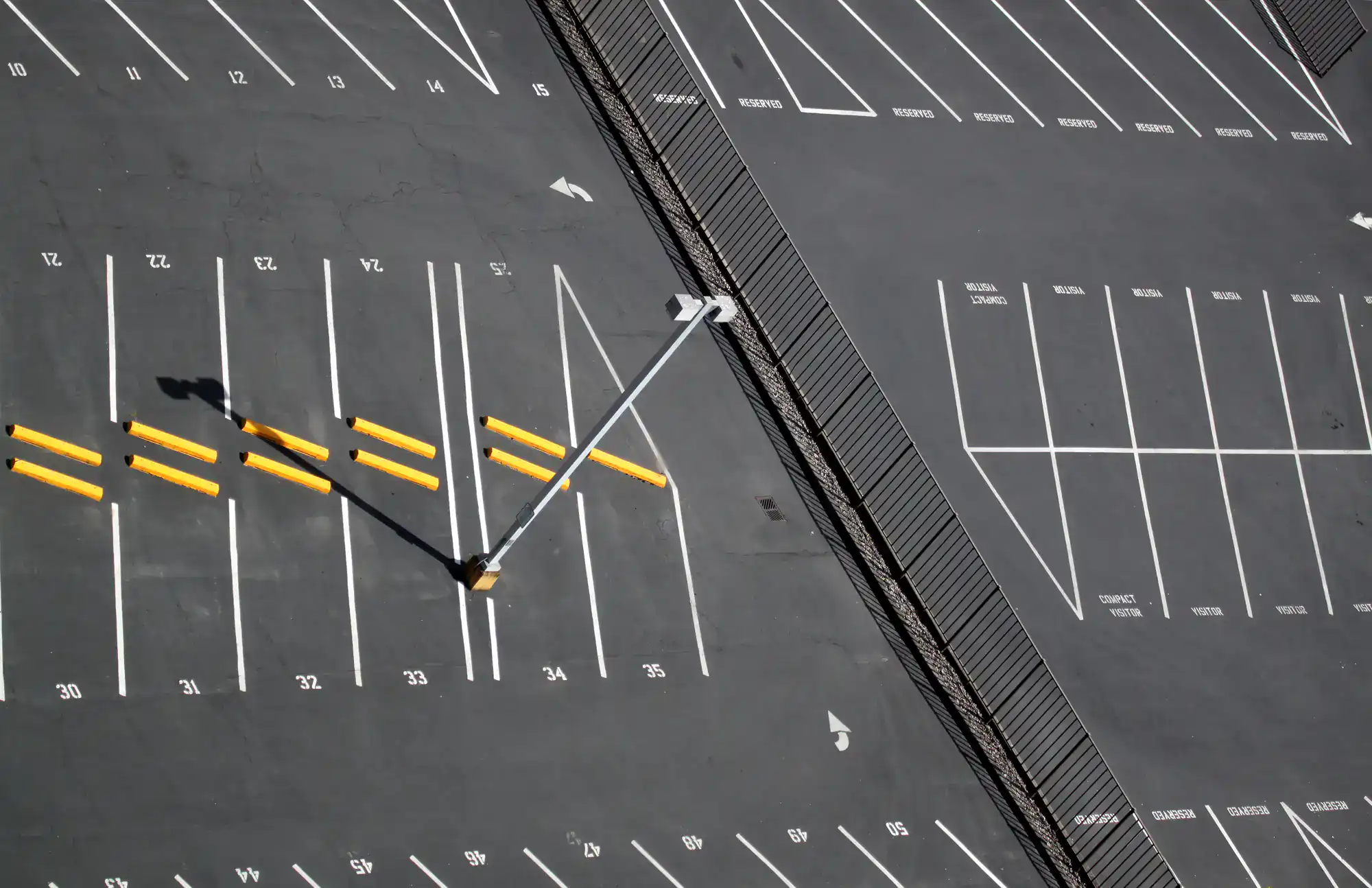
This is where a lot of property owners get caught off guard. ADA compliance for parking lots isn’t just about painting a blue handicap symbol on the ground. The 2010 ADA Standards for Accessible Design set specific dimensional requirements that every accessible space must meet — and Florida’s own Building Code incorporates those standards with additional provisions that make compliance here stricter than the federal baseline in several areas.
Here’s what the actual requirements look like. Each accessible parking space must be at least 96 inches wide — that’s 8 feet. Alongside each space, there must be an access aisle at least 60 inches wide. Van-accessible spaces require either a 132-inch-wide space with a 60-inch aisle, or a standard 96-inch space with a 96-inch aisle. Signage must be mounted at a minimum of 60 inches above the finished grade. And the surface slope cannot exceed 1:48, which works out to about 2 percent — a detail that’s easy to overlook and expensive to get wrong.
The number of accessible spaces you’re required to provide depends on the total size of your lot. For every six accessible spaces — or fraction thereof — at least one must be van-accessible. A contractor who doesn’t know these ratios going in is already setting you up for a problem.
Here’s the part that surprises most people: under federal law, any time a business restripes a parking lot, it must bring the entire accessible parking area into compliance with current ADA standards. This isn’t limited to new construction. The moment you hire someone to refresh your lines, you’ve triggered the obligation. That’s why the contractor you choose matters so much — not because of aesthetics, but because an incorrect job creates legal exposure that starts the day the paint dries.
Florida has a notably high rate of ADA “tester” lawsuits — individuals who specifically target businesses with non-compliant parking lots. Subsequent violations can run $150,000. A private lawsuit settlement averages around $10,000 on top of that. A professional restriping job is a fraction of any of those numbers.
This is one of the most common questions we hear, and the honest answer is: it depends heavily on who did the work and what materials they used.
In Polk County’s climate specifically, high-traffic commercial lots that are properly striped with traffic-grade paint and appropriate surface prep typically hold up for 12 to 24 months before restriping is warranted. Lower-traffic lots can stretch further. But our combination of intense UV exposure, heavy seasonal rain, and the heat that asphalt absorbs and radiates throughout the summer creates conditions that will expose any shortcuts quickly.
Water-based latex paint — the kind a general contractor might use because it’s cheap and available — degrades fast under these conditions. Traffic-grade paint formulated for high-UV, high-rainfall environments holds significantly longer. The difference in material cost is minor. The difference in how long the job lasts is not.
There are also specific trigger events that make restriping necessary regardless of how the lines look. Sealcoating is the most common one. Sealcoating is one of the best things you can do for an asphalt surface — it extends the pavement’s life, protects against oxidation, and gives the lot a clean, professional appearance. But it covers every existing line completely. The moment sealcoating is applied, the entire lot needs to be restriped. Property managers who handle both services together — rather than coordinating two separate contractors — tend to get better results and fewer scheduling headaches.
Post-storm restriping is another real demand driver in this market. Polk County sits squarely in Florida’s hurricane corridor, and the heavy rain that comes with storm season accelerates fading on lines that were already showing wear. After a significant weather event, it’s worth a walk through your lot to assess where you stand before the next inspection cycle.
Want live answers?
Connect with a Central Florida Blacktop Paving expert for fast, friendly support.
A parking lot does more than hold cars. It’s the first thing a customer, tenant, or visitor interacts with when they arrive at your property. On the I-4 corridor running through Polk County — where commercial properties serve customers coming from both Tampa and Orlando — that first impression carries real weight.
We work with commercial property owners and managers throughout Polk County, from the US-98 corridor in Lakeland to the Champions Gate and Davenport retail areas, to warehouse and logistics facilities that need clear traffic flow markings across large surfaces. The scope of striping work varies, but the standard doesn’t.
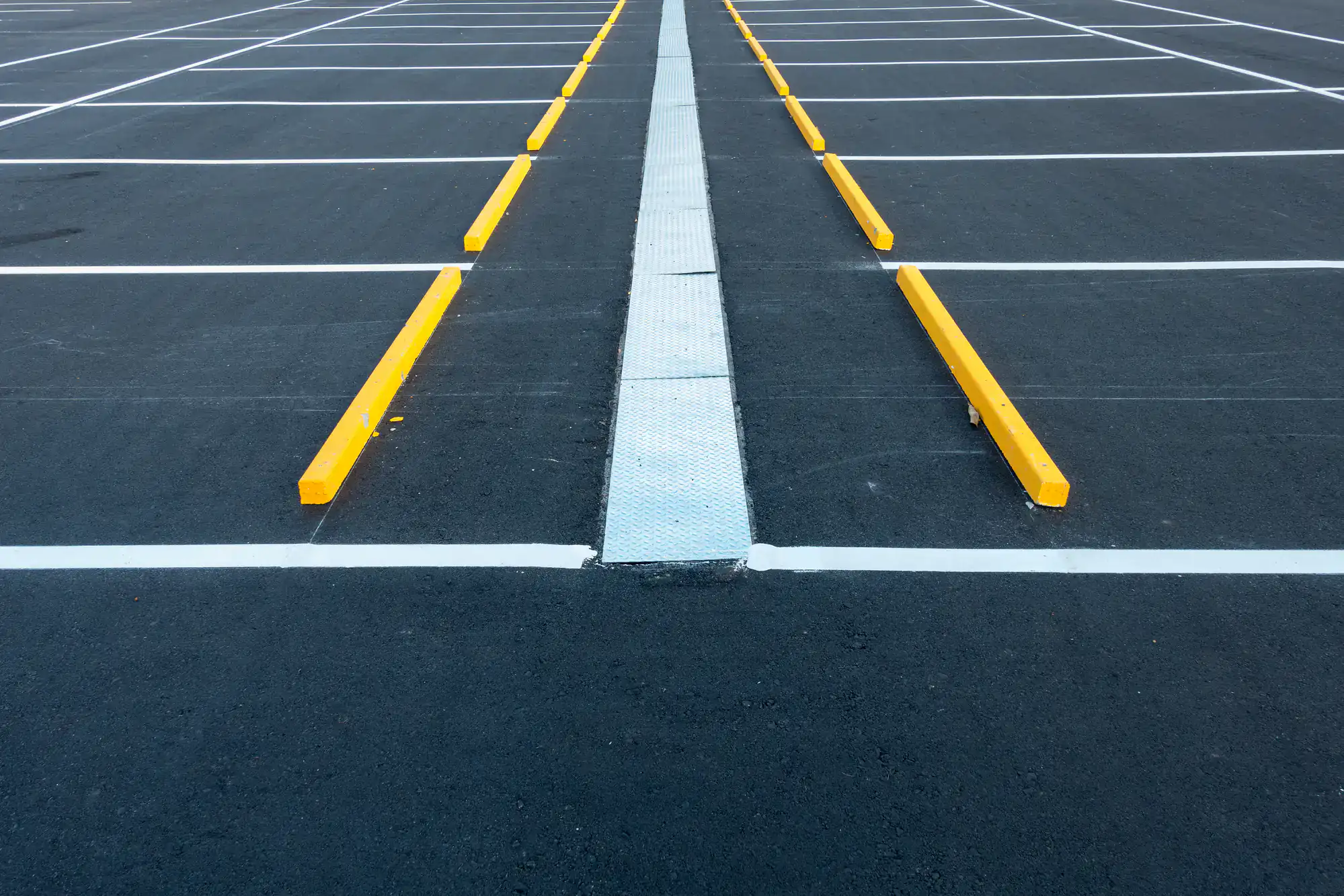
A complete commercial parking lot striping job covers more ground than most people picture when they think about line painting. Standard parking space lines are the foundation, but a fully marked lot also includes ADA-designated accessible spaces with correct dimensions and access aisles, van-accessible spaces with the appropriate aisle width, fire lane markings along building perimeters, directional arrows for traffic flow, no-parking zones, loading zone markings, and handicap symbols using ADA-compliant stencils.
For larger properties — distribution facilities, shopping centers, medical office campuses — traffic flow markings are particularly important. Poorly designed or faded directional markings create confusion, increase the risk of vehicle conflicts, and can contribute to accidents that put the property owner in a difficult position legally. Clear, well-placed arrows and lane designations keep traffic moving predictably and reduce the conditions that lead to incidents.
For properties near high-traffic destinations in Polk County — think the retail corridors around Winter Haven or the commercial development that’s followed LEGOLAND Florida’s growth — parking lot organization also affects how customers experience the property before they ever walk through the door. A chaotic, poorly marked lot sends a message. A clean, clearly marked one does too.
We use state-of-the-art mechanical striping equipment that produces consistent line width, straight edges, and uniform paint coverage across the entire surface. This isn’t a minor detail. Wavy lines, uneven edges, or inconsistent width aren’t just aesthetically off — they signal that the work was done without proper equipment or care, and they wear unevenly over time.
Property managers overseeing multiple sites have a specific set of concerns that single-location owners don’t always share. Consistency matters — not just quality on any one job, but the same standard of quality replicated across every property in the portfolio. A contractor who does excellent work at one location and inconsistent work at another creates headaches that compound over time: different compliance documentation, different restriping schedules, different relationships to manage.
What you’re really looking for is a contractor who understands your standards, communicates clearly about scheduling and scope, and can be relied on to deliver the same result whether they’re working on a Lakeland medical office parking lot or a Bartow retail center. Polk County’s commercial market has grown fast — the county’s population is pushing past 800,000 and development along the I-4 corridor shows no sign of slowing — and that growth has attracted a lot of contractors who are new to the market and still figuring out Florida’s specific climate and code requirements.
Forty years of experience in Polk County means something different from forty years of general paving experience somewhere else. Our sandy soil affects base behavior. Florida’s heat affects how asphalt expands and how paint adheres. The Florida Building Code adds layers of compliance that contractors from other states or newer to this market don’t always know to look for. When we assess a parking lot before striping it, we’re not just looking at the lines — we’re looking at the surface condition, the slope, the existing accessible space layout, and whether what’s there currently meets the standard or needs to be corrected.
We also communicate directly. You’ll speak with the owner — not a scheduler, not a sales rep, not a crew foreman who may or may not relay the details correctly. For property managers juggling multiple vendor relationships, that directness tends to make a real difference in how smoothly projects run.
The decision usually comes down to this: do you want the cheapest option, or do you want the job done correctly the first time? In Florida’s legal environment, those two things are rarely the same. A low-bid striping job that produces incorrect ADA dimensions or non-compliant signage doesn’t save you money — it creates exposure that costs far more to resolve than the job itself.
What you should expect from a qualified contractor is straightforward: knowledge of ADA and Florida Building Code requirements, traffic-grade materials suited for Florida’s climate, proper surface preparation before any paint is applied, and documentation of the work that demonstrates compliance.
If your Polk County commercial property needs restriping — whether it’s been a few years, you’ve recently had the lot sealcoated, or you’ve never had a formal ADA compliance review — we’re worth a call. We’ve been doing this work in Polk County for over 40 years, and we’re not going anywhere.
Article details:
Share:
Continue learning: