Not every blacktop sealing company in Polk County is who they say they are. Here's how to tell the difference before you hand over a deposit.
Share:
Summary:
You’ve probably seen the trucks. Sometimes they knock on your door. They’ve got leftover material from a job around the corner, they say, and they can give you a deal today if you pay cash. It sounds reasonable. It usually isn’t.
Florida has a well-documented problem with traveling paving crews — and Polk County, one of the fastest-growing counties in the entire country, is a prime target. Thousands of new residents arrive every year without established contractor relationships, which makes the area attractive to operators who aren’t planning to stick around.
This guide exists to help you hire smarter. We’ll cover what separates legitimate blacktop sealing companies from the ones you’ll regret, and what to look for before any work starts.
The paving industry is one of the most fragmented contractor markets in the country — no single company holds more than 5% market share nationally, which means the barrier to entry is low and the range in quality is enormous. In a market like Polk County, where construction is booming and new homeowners are still finding their footing, that fragmentation creates real risk.
Choosing the right sealcoating contractor starts with verification, not price. Before you compare quotes, confirm the company is licensed under Florida’s Paving Specialty Contractor category, carries both liability insurance and workers’ compensation, and has a verifiable local presence — a real address, a local phone number, and reviews you can actually read.
Polk County ordinance requires any contractor advertisement to include a state license or certificate of competency number. If you’re looking at a flyer, a door hanger, or a website that doesn’t show one, that’s not a minor oversight. It’s a red flag.
A legitimate local driveway sealing company shouldn’t hesitate when you ask for documentation. Their license number should be easy to find — on their website, their truck, their estimate. Their insurance certificates should be available on request. And their BBB rating, if they have one, is publicly searchable in about thirty seconds.
Beyond credentials, pay attention to how we communicate before the job starts. Do we return calls promptly? Do we give you a written, itemized estimate — or just a number scrawled on a business card? The presence of a written quote is one of the clearest signals that you’re dealing with a professional operation. Verbal-only pricing is how bait-and-switch billing happens. There are documented cases in Florida of homeowners being quoted a few dollars per foot verbally, then handed a bill for tens of thousands at completion.
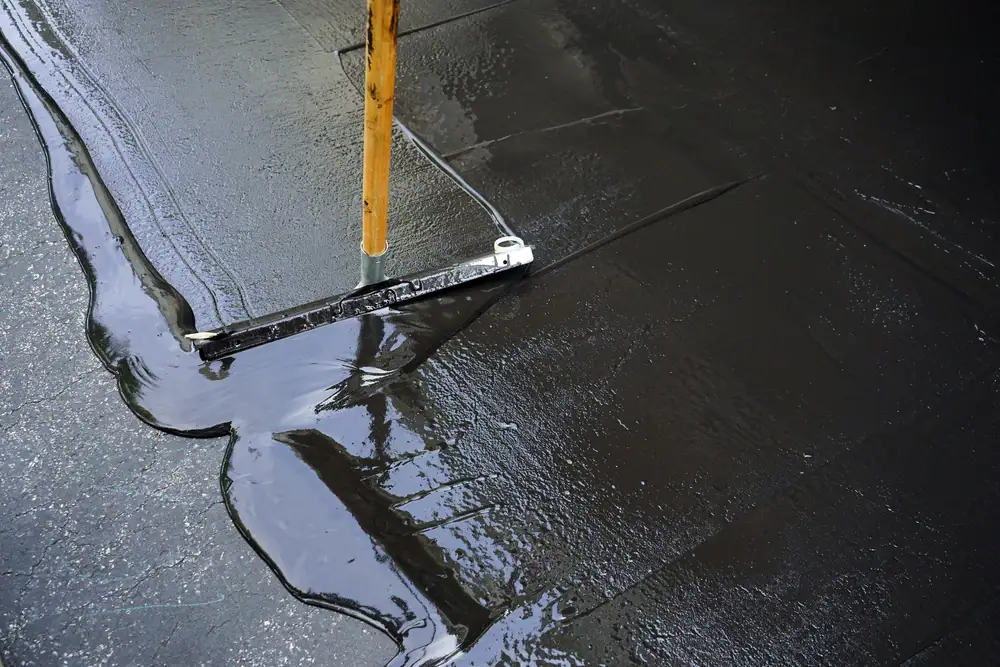
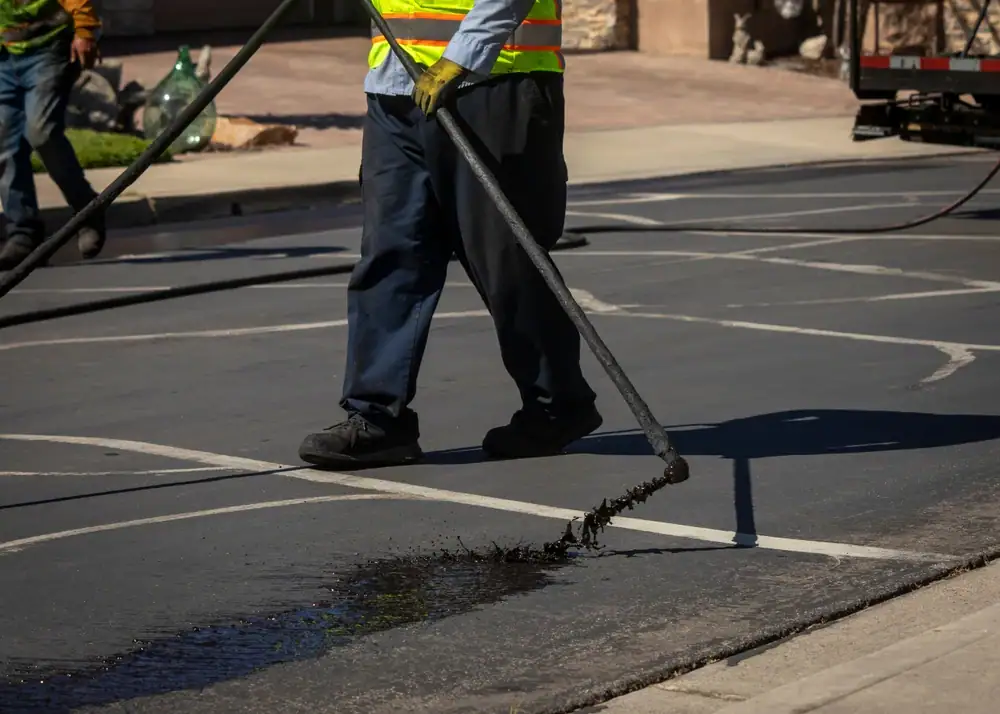
The preparation process is another telling sign. Sealcoating done right isn’t just spraying product on pavement. It starts with a thorough surface cleaning, crack filling, damage repair, and proper adhesion prep — before a single drop of sealer is applied. Two thin coats, not one, is the professional standard. Contractors who skip prep or apply one thick coat are cutting corners that show up within months, not years.
Ask what sealer we use. Commercial-grade asphalt emulsion sealers formulated for Florida’s climate are the appropriate choice — not watered-down retail products, and not oil-based alternatives that look shiny but don’t protect. If a contractor can’t explain what they’re applying or why, that’s worth noting.
Also ask about drainage. Polk County gets over 50 inches of rain annually, most of it concentrated between June and September. Pavement that doesn’t drain properly develops water infiltration problems underneath the surface — and that’s structural damage, not cosmetic. Any contractor who doesn’t mention drainage planning during a site assessment either doesn’t know the area or doesn’t care about the outcome.
This is something out-of-state crews consistently get wrong, and it matters more than most homeowners realize. Polk County’s sandy soil — particularly in areas like South Lakeland and Cleveland Heights — shifts and settles in ways that put real stress on asphalt. If the base underneath isn’t properly compacted before installation, you’ll see cracking within months. Not because the sealer failed, but because the foundation was never right.
Contractors who work in Polk County regularly understand this. We account for it in our base preparation. Contractors who are passing through, doing a few jobs before moving to the next county, often don’t. They apply the same process they’d use in Ohio or Georgia, and it doesn’t hold up here.
Florida’s heat adds another layer of complexity. Standard asphalt mixes designed for northern climates soften in sustained summer temperatures. Polymer-modified asphalt, formulated specifically for high-heat environments, is what the climate here actually demands. When a contractor talks about material specifications and mentions Florida-specific formulations, that’s a sign they’ve done this work here for a while — not just once or twice.
The absence of freeze-thaw cycles is actually a point in Florida’s favor. Northern asphalt faces constant contraction and expansion from winter temperatures, which accelerates deterioration. Here, the primary threats are UV oxidation, moisture infiltration, and heat. All three are manageable with proper materials and regular maintenance — typically sealcoating every two to three years. Properly maintained asphalt in Central Florida can last 20 to 30 years. Neglected asphalt, or asphalt sealed with the wrong materials by the wrong contractor, won’t come close.
One more thing worth knowing: Florida House Bill 735, which took full effect in July 2025, reduced local licensing requirements for certain contractor categories, including paving. The intent was to streamline permitting, but the practical effect is that it’s now easier for unqualified operators to work in Polk County without local oversight. That makes verifying state-level credentials more important now than it was even a year ago.
Want live answers?
Connect with a Central Florida Blacktop Paving expert for fast, friendly support.
The U.S. EPA’s Office of Inspector General has issued a formal fraud alert specifically about asphalt sealer scams. Florida county sheriffs — including in counties directly adjacent to Polk — have published public warnings about door-to-door paving crews. The BBB Scam Tracker documents individual homeowners losing up to $8,000 in single incidents.
This isn’t a fringe problem. It’s common enough that federal and local agencies have made it a formal public safety issue.
The most frequent setup involves someone knocking on your door, claiming they just finished a job nearby and have leftover material they’d rather use than haul away. They offer a deal. They want cash. They want it now. Legitimate contractors don’t operate this way — professional sealcoating requires planned material orders, scheduled crew time, and equipment that doesn’t just happen to be parked on your street.
You don’t need a long checklist. A few direct questions will tell you most of what you need to know.
Ask for the state license number and look it up. Florida’s contractor license database is publicly accessible, and a legitimate company will give you their number without hesitation. If there’s any deflection — “we work under our supplier’s license,” “we’re in the process of renewing” — stop there.
Ask for proof of insurance. Both general liability and workers’ compensation. If something goes wrong on your property and the contractor isn’t properly insured, you may be the one absorbing the cost. This is non-negotiable.
Ask for a written, itemized estimate. Line items should include surface cleaning, crack filling, any patching or repair work, the number of coats being applied, and the material being used. A single number with no breakdown is not an estimate — it’s an invitation to a dispute later.
Ask how long they’ve worked in Polk County specifically. A contractor who’s been sealing driveways in Lakeland, Winter Haven, and Davenport for years has a track record you can investigate. A crew that showed up this spring does not.
Ask about the curing timeline and what you should expect afterward. In Florida’s climate, sealcoating typically needs 24 to 48 hours before foot traffic and about two weeks before regular parking. A contractor who says it’ll be ready in a few hours is either using inferior materials or telling you what you want to hear.
Finally, ask what happens if there’s a problem. Is there a warranty? Is it in writing? Will they come back if something fails early? Contractors who intend to still be reachable next month answer this question directly. Contractors who don’t, won’t.
Some warning signs are subtle. Others aren’t. Here are the ones worth knowing before you let anyone near your driveway.
Cash only, full payment upfront. This is the single most consistent indicator of a scam operation. Legitimate contractors take a reasonable deposit — not the full amount before a single square foot has been touched. Cash-only demands also eliminate any paper trail, which is the point.
No company name or license number on the truck. Professional contractors have branded vehicles. Magnetic signs that can be swapped between jobs are a documented tactic among traveling scam crews who cycle through different company names to avoid accountability.
High-pressure urgency. “We can only do this today,” “the price goes up if we come back,” “we’re already set up around the corner.” Real contractors schedule work. They don’t manufacture artificial deadlines to prevent you from thinking too carefully.
No written documentation of any kind. If they won’t put the scope of work, the materials, the price, and the timeline in writing, there’s a reason for that.
Suspiciously low pricing. Sealcoating a typical driveway costs what it costs — materials, labor, equipment, prep time. A bid that’s dramatically lower than everyone else’s isn’t a deal. It’s either a sign of inferior materials, skipped prep work, or a contractor who has no intention of finishing the job properly.
Polk County’s rapid growth — and the large number of residents who’ve moved here recently from out of state — makes this market particularly attractive to traveling crews. If you moved here from the Midwest or the Northeast in the last few years, you may not have a trusted local contractor yet. That’s exactly the gap these operators are counting on.
The goal here isn’t to make you paranoid — it’s to make you a harder target. Most of what separates a good sealcoating contractor from a bad one comes down to a few verifiable things: credentials you can look up, documentation we’ll put in writing, and a local track record that predates your search.
We’ve been doing asphalt work in Polk County for over 40 years. We know the soil conditions in South Lakeland. We know what Florida summers do to the wrong materials. We know that a driveway in Davenport or Haines City needs different base preparation than one in a northern climate. That’s not a talking point — it’s what four decades of working in this specific place teaches you.
If you’re evaluating contractors right now, we’re happy to talk through your project, answer your questions, and give you a written estimate at no cost. No pressure, no urgency tactics. Just a straight conversation. Reach out to Central Florida Blacktop Paving Inc. and find out what an honest assessment actually looks like.
Article details:
Share:
Continue learning: