Florida's climate is hard on asphalt. Here's what sealcoating actually does, how often you need it in Polk County, what it costs, and how to hire a contractor you can trust.
Share:
Summary:
Most people don’t think about their driveway until something’s obviously wrong — a crack that keeps spreading, a surface that’s gone from black to a dull, dusty gray, or a rough patch that catches your eye every time you pull in. By that point, you’re not just dealing with a cosmetic issue. You’re dealing with a driveway that’s already started breaking down.
In Polk County, that process happens faster than almost anywhere else in the country. The combination of UV intensity, heavy summer storms, and the wet-dry cycles of Florida’s rainy season puts asphalt under real stress, year after year. Driveway sealcoating is what slows that down. Here’s how it works, what it actually costs, and what to look for when you’re ready to hire someone.
Sealcoating and driveway sealing are terms that get used interchangeably, and for good reason — they describe the same basic service. A protective coating is applied over your existing asphalt surface to block the elements that cause it to deteriorate: UV radiation, water, oil, and chemical spills.
What makes Polk County different is the intensity of those elements. The area averages over 50 inches of rain a year, most of it concentrated between June and September. Afternoon storms can dump inches in minutes. Combined with some of the highest UV index readings in the continental U.S., your asphalt is taking a beating that northern driveways simply don’t experience at the same pace.
The result is that unsealed asphalt in Polk County typically shows visible cracking within three to five years. Sealed surfaces — properly maintained — can stay structurally sound for 15 years or more.
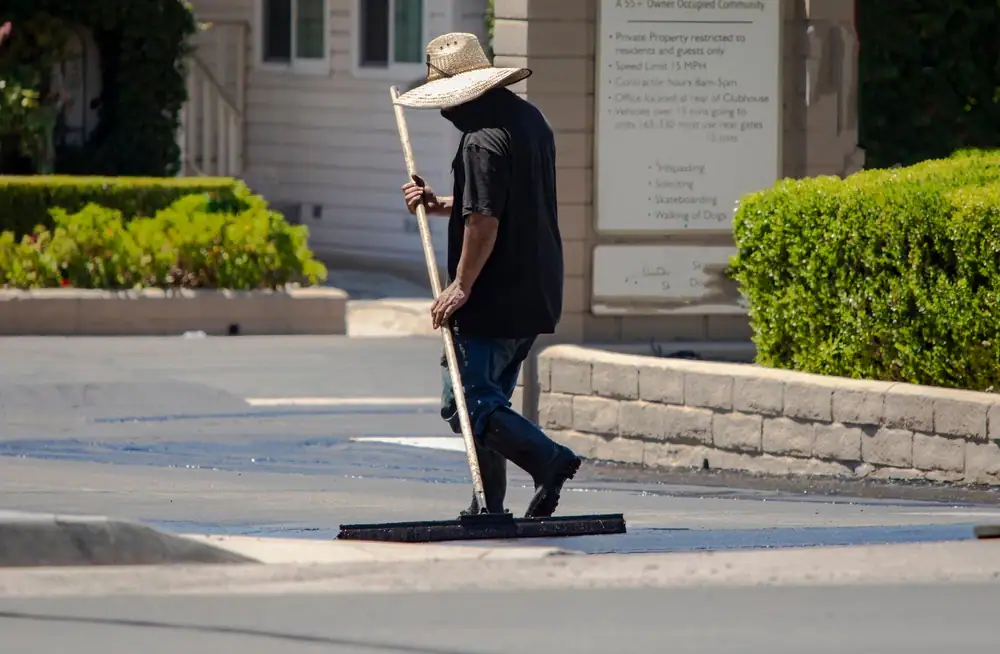
The process matters more than most people realize, and it’s one of the clearest ways to tell a professional job from a rushed one.
Before any sealer touches your driveway, the surface needs to be cleaned — blown clear of debris, degreased in any spots where oil has soaked in, and inspected for existing cracks. Those cracks need to be filled before the sealcoat goes down. Applying sealer over open cracks doesn’t fix them. It just covers them temporarily while water continues to work its way in underneath.
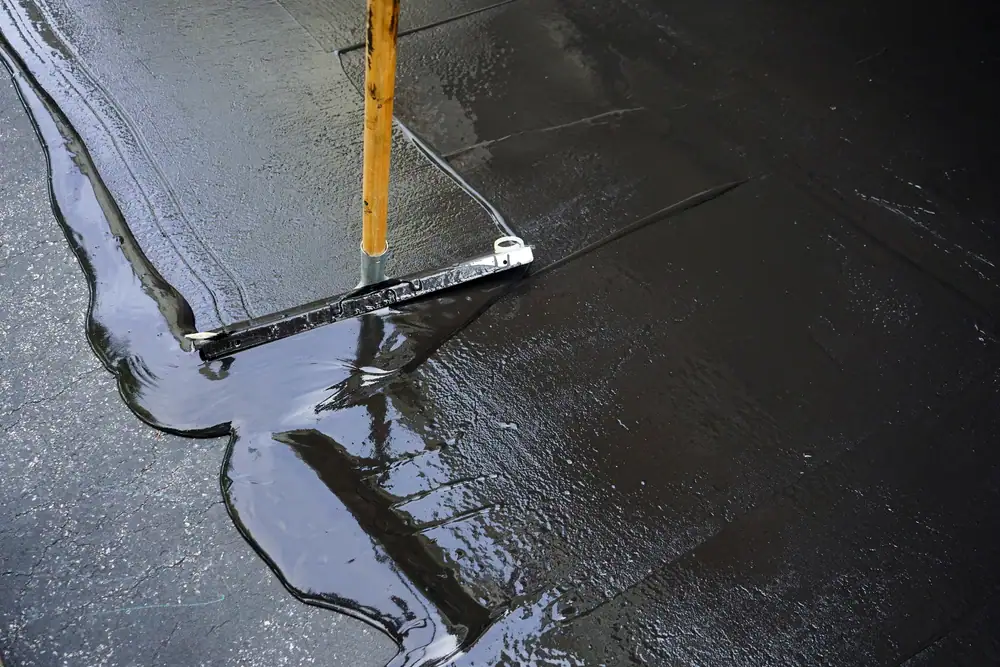
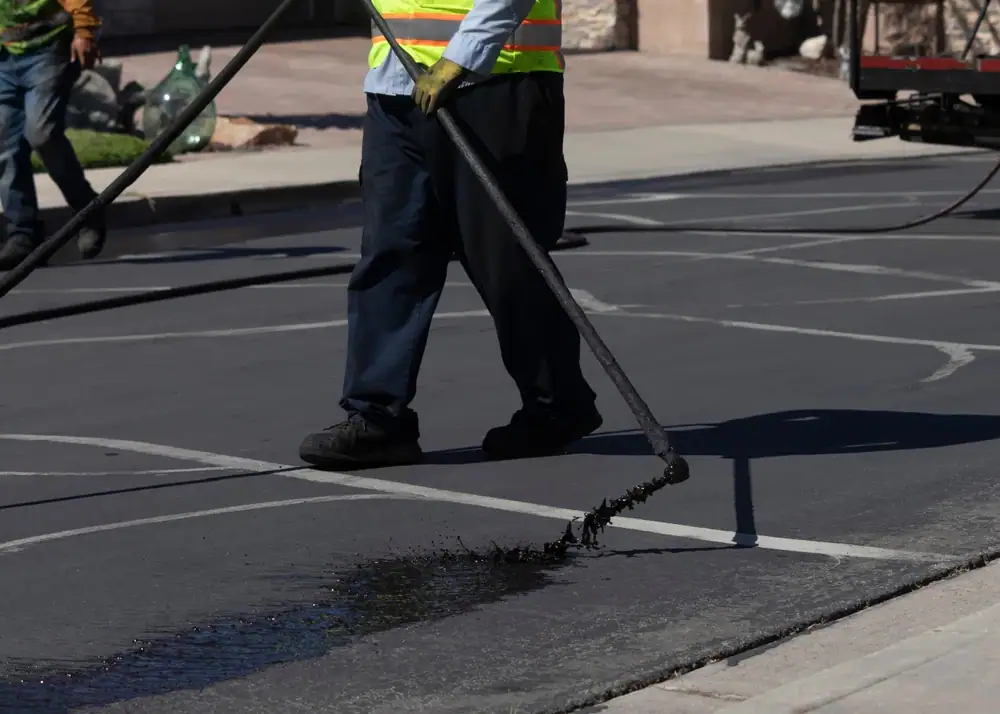
Once the surface is properly prepped, we apply two coats using commercial spray equipment. The equipment matters here. Our sealcoating rigs use tanks with hydraulic agitation — a system that keeps the sealer continuously mixed so it applies at a consistent thickness and the sand additives stay evenly distributed throughout. What you don’t want is a contractor showing up with a non-agitated drum and a brush. That’s not a professional setup, and the results reflect it.
After application, the sealer needs time to cure. In Polk County’s warm conditions, that’s typically 24 to 48 hours. Humidity can extend that window, which is why we pay attention to the forecast before scheduling a job — not just whether it’s going to rain, but whether the overnight humidity will allow the surface to set properly.
The difference between a sealcoat that lasts three to five years and one that starts peeling within a season almost always comes down to preparation and application quality. The product matters too — asphalt emulsion sealers are generally better suited to Florida’s heat than coal tar alternatives — but even the best sealer fails if the surface wasn’t cleaned properly or the coats were applied too thin.
We’ve been doing this work in Polk County’s specific climate for over 40 years. That experience shows up in the details: knowing when to schedule around the rainy season, how to handle the clay soils around Lakeland’s lake district that shift seasonally, and how to grade surfaces so water drains away rather than pooling and pressing into the pavement from above.
The national standard recommendation for sealcoating frequency is every three to five years. In Polk County, we recommend every two to three years for most properties, and the reasoning is straightforward: Florida’s UV exposure and rainfall intensity accelerate the breakdown of the sealer itself, not just the asphalt underneath it.
A properly applied sealcoat retains about 95% of the asphalt’s structural integrity after seven years, according to research from the University of Texas. Without sealing, that number drops to around 65% over the same period. Water penetration into sealed pavement is reduced by 70 to 80 percent compared to unsealed surfaces. Those aren’t minor differences — they’re the gap between a driveway that needs a reseal and one that needs to be replaced.
New driveways need their first sealcoat within six to twelve months of installation. The asphalt needs time to cure and off-gas before sealing, but waiting too long lets UV oxidation get a head start. If you’ve recently had a new driveway installed in Davenport, Auburndale, or anywhere else in Polk County, that window matters.
Over-sealing is also a real issue worth knowing about. Applying a new coat before the previous one has worn down creates buildup that can crack and peel on its own. If your driveway was sealed recently and still looks good, you don’t need to reseal it yet. We’ll tell you that — even if it means you don’t hire us today.
The long-term math is not complicated. Resealing costs roughly $0.15 to $0.25 per square foot every two to three years. Crack filling without sealing runs $1 to $3 per linear foot annually. Full driveway replacement is $8 to $15 per square foot. Consistent sealcoating is the least expensive option on that curve by a significant margin — and skipping it doesn’t save money, it just delays and multiplies the cost.
Want live answers?
Connect with a Central Florida Blacktop Paving expert for fast, friendly support.
Pricing is where a lot of homeowners get stuck, mostly because contractors rarely publish numbers and the quotes can vary wildly. That uncertainty is uncomfortable, especially in a market where lowball prices often signal a scam rather than a deal.
For a typical residential driveway in Polk County — around 2,000 square feet — professional sealcoating generally runs between $200 and $600. The range depends on the condition of the surface, whether crack filling is needed beforehand, how many coats are required, and the contractors’ materials and equipment. A quote at the very low end of that range from a door-to-door solicitor should raise questions, not excitement.
We provide written estimates before any work begins. The price you’re quoted is the price you pay. That’s not a standard practice in this industry — but it should be.
Several factors move the needle on what your specific job will cost, and understanding them helps you evaluate quotes more confidently.
Surface condition is the biggest variable. A driveway that’s clean, crack-free, and in good shape requires less prep work and goes faster. A surface with significant cracking, oil staining, or edge deterioration needs more preparation before sealing, which adds time and cost. That preparation is not optional if you want the job to last — skipping it is how contractors cut corners without you noticing.
Square footage is straightforward. Larger driveways cost more in materials and time. But the per-square-foot rate often decreases slightly on bigger jobs, so a long driveway on an acreage property in Lake Wales or a private road in a rural part of Polk County may cost less per square foot than a compact suburban driveway in Lakeland.
The number of coats matters too. A single thin coat is not a complete sealcoating job, regardless of what the invoice says. Two coats are the professional standard. Some contractors quote low by planning to apply one coat and hope you don’t notice the difference. You will — usually within the first season, when the surface starts showing wear unevenly.
Material quality affects both cost and longevity. Professional-grade sealers formulated for Florida’s heat perform significantly better than consumer-grade products available at home improvement stores. The difference in upfront cost is modest. The difference in how long it lasts is not.
Finally, timing and scheduling can affect price in some cases. Jobs scheduled during slower periods or booked well in advance may come in at a better rate. Because we operate year-round, we can often find the right weather window without forcing you into a peak-season schedule.
The real cost comparison isn’t between sealcoating and a cheaper sealcoating job. It’s between sealcoating and not sealcoating at all.
When asphalt goes unsealed in Florida’s climate, oxidation begins immediately. UV radiation breaks down the binder that holds the aggregate together. The surface grays, becomes brittle, and starts cracking — typically within three to five years on an unprotected driveway. Once cracks form, water gets in. In Polk County, where the water table around Lakeland’s 38 lakes is already elevated and clay soils shift seasonally, that water doesn’t just sit — it undermines the base, accelerates cracking, and eventually turns a surface repair into a full replacement conversation.
The cost escalation is real and well-documented. Repairs on a neglected driveway run five to ten times more than the preventive sealcoating that would have slowed the damage down. A commercial property owner managing a parking lot along South Florida Avenue or the US-27 corridor through Davenport is looking at the same math, just at a larger scale — the Pavement Coatings Technology Council has documented a total 12-year cost of $0.39 per square foot for maintained commercial pavement versus $1.76 per square foot for unmaintained. That’s a 4.5-to-1 difference.
None of this means you should panic if your driveway has been unsealed for a few years. It means the longer you wait, the fewer options you have and the more expensive each of those options becomes. A driveway that needs a reseal today might need crack repair and a reseal in two years, and a full resurface in five. The maintenance timeline is not static — it accelerates.
If you’re not sure where your driveway falls on that curve, a free consultation gives you a straight answer. We’ll tell you what the surface actually needs, not what generates the largest invoice.
The sealcoating industry has a legitimate scam problem. Door-to-door operators with “leftover material,” demands for full cash payment upfront, and diluted sealer applied with non-professional equipment are well-documented realities — not just cautionary tales. The best defense is knowing what a legitimate job looks like before someone shows up at your door.
A trustworthy contractor shows up with commercial spray equipment, provides a written estimate before starting, specifies the materials being used, fills cracks before sealing, and applies two coats. They carry a valid Florida contractor’s license and insurance. They don’t demand full payment before the work is done.
We’ve been doing this work in Polk County for over 40 years. We’re licensed, insured, and A+ rated with the Better Business Bureau. We do asphalt only — no concrete, no pavers — which means every piece of equipment we own and every hour of experience we’ve built is focused on one thing. If you have questions about your driveway or want to know what it actually needs, reach out to Central Florida Blacktop Paving Inc. for a free consultation. No pressure, no vague estimates — just a straight answer from someone who’s been working in this county long enough to know what Florida asphalt actually requires.
Article details:
Share:
Continue learning: